Most of your money works the same way wherever you live in the United Kingdom, but not all of it. Income tax on your wages is set differently in Scotland from anywhere else in the UK, and the Scottish Parliament now runs its own disability and carer benefits through Social Security Scotland. Wales sets its own income tax rates, though for now they match England's. Northern Ireland runs its own benefits system through the Department for Communities, keeps domestic rates instead of council tax, and is left out of some UK-wide legislation entirely.
The biggest single difference most people notice is income tax. If you live in Scotland, you pay Scottish Income Tax on your wages and pension, and the money goes to the Scottish Government rather than the UK Treasury1. For 2026 to 2027, Scottish taxpayers earning less than around £33,500, which the Scottish Government expects to be around 55% of Scottish taxpayers, pay slightly less than they would elsewhere in the UK, while higher earners pay more, with a top rate of 48% on income above £125,1402. Savings interest and dividends, by contrast, are taxed at exactly the same rates across the whole UK.
Which parts of your money depend on where you live
The UK Parliament at Westminster keeps responsibility for the foundations of the tax system. Responsibility for the Income Tax base, including reliefs and exemptions, the tax-free Personal Allowance, and Income Tax on savings and dividends, remains reserved to the UK Parliament3. What Scotland and Wales control is the rates and bands applied to non-savings, non-dividend income: wages, pensions, self-employed profits and the like. Scottish Income Tax is described by Revenue Scotland as "a partially devolved tax", collected by HMRC, with rates and bands set by the Scottish Parliament and published alongside the Scottish Budget6.
Beyond income tax, the differences multiply. Scotland has its own property purchase tax (Land and Buildings Transaction Tax), Wales has the Land Transaction Tax, and England and Northern Ireland have Stamp Duty Land Tax, each with different rates and thresholds. Scotland and Wales run council tax with their own bands and rules, while Northern Ireland keeps the old domestic rates system. Water charges work differently too: Scottish households pay for water through their council tax bill, while in England and Wales it is a separate metered or unmetered bill. The detailed pages on property purchase taxes, council tax in Scotland, council tax in Wales, domestic rates in Northern Ireland and water bills cover each of these.
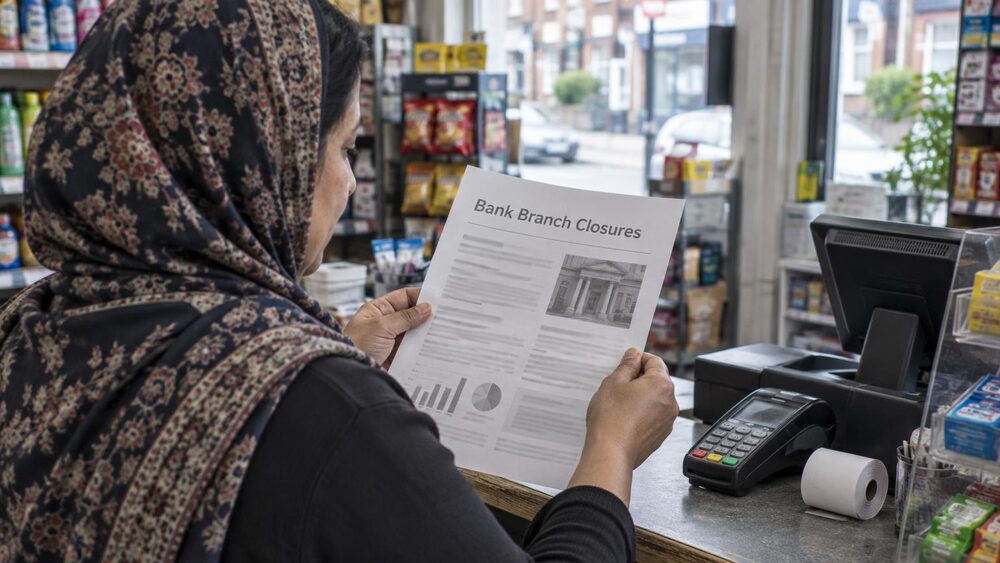
Banking, by contrast, is largely UK-wide. UK-wide, 92% of personal current accounts, 85% of mortgages and 88% of small business accounts are owned by commercial banks operating across the whole country7. The Post Office framework allows 99 percent of personal banking customers to deposit cheques, check their balance and withdraw cash through post office counters8, which matters most in the parts of Scotland, Wales and Northern Ireland where bank branches have closed. The pages on banks in Scotland and banks in Northern Ireland cover the local picture.
One rule that does not change at all is where your tax liability comes from. If you are resident and domiciled in the UK, you are liable to UK tax on the arising basis on capital gains made in the UK or elsewhere9. Where you live within the UK changes which rates apply and which government receives the money, not whether you owe it.
Scottish Income Tax: six bands from 19% to 48%
Scottish Income Tax for 2026 to 2027 has six bands, more than anywhere else in the UK. With the standard Personal Allowance of £12,570, the bands run from a 19% starter rate up to a 48% top rate on taxable income above £125,1402. The full structure is:
The six-band structure is recent. In 2018 to 2019, Scottish Income Tax moved to a five-band policy with rates of 19%, 20%, 21%, 41% and 46%10. In 2024 to 2025 it changed again, introducing the advanced rate of 45%, placed between the amended higher rate of 42% and the top rate of 48%11. The Scottish Parliament's own briefing for 2026 to 2027 confirms the same band limits and rates now in force12, and the published rates and bands page for 2026 to 2027 sets out the higher band at £43,663 to £75,000 at 42%13.
What this means for the amount of tax you actually pay depends on where your income falls. The Scottish Government's technical factsheet for the 2026 to 2027 policy package states that no taxpayer will pay more Scottish Income Tax in 2026 to 2027 than they did in 2025 to 2026 on their current income2. It also states that taxpayers earning the median income of around £31,136 will be around £24 better off than if they lived elsewhere in the UK, and around £32 better off than they were in 2025 to 20262. Taking deductions such as pension contributions into account, the proportion of Scottish taxpayers set to pay less than in the rest of the UK is expected to be around 57%, and around 62% of households in Scotland are better off or unaffected under Scotland's system compared with the rest of the UK2.
The 2026 to 2027 changes also lifted the thresholds. The Starter rate band limit increases by 40.3% and the Basic rate band limit by 13.6%, with the thresholds for paying both the Basic and Intermediate rates increasing by 7.4%2. The Higher, Advanced and Top rate thresholds are assumed to be maintained at their current levels in cash terms until the end of the Spending Review period, 2028 to 20292. Many adults are untouched by any of this: over 32% of Scottish adults, around 1.5 million out of 4.7 million, have incomes below the UK-wide Personal Allowance of £12,570 and are not affected by the policy changes, and a further 7%, around 330,000 Starter rate taxpayers with income below the Basic rate threshold, are also unaffected2.
The dedicated page on Scottish and Welsh income tax goes into the bands, rates and who pays what in more detail.
Savings and dividends are taxed the same across the UK
This is the point most often misunderstood. Scottish Income Tax applies to wages, pensions and most other taxable income, including self-employed profits, rental income and taxable benefits such as the State Pension and Carer's Allowance14. It does not apply to savings interest or dividend income14. HMRC's guidance is plain: "You'll pay the same tax as the rest of the UK on dividends and savings interest"1.
The reason is constitutional rather than practical. The responsibility for defining the Income Tax base, which includes the setting or changing of Income Tax reliefs and exemptions, the tax-free Personal Allowance, and Income Tax on savings and dividends, remains reserved to the UK Parliament3. The Scottish Parliament can move the rates and bands on earned income, but it has no power over the Personal Allowance, over ISA rules, or over the tax treatment of savings and dividends.
So a saver in Glasgow with £20,000 in a savings account, or an investor in Cardiff holding shares outside an ISA, is taxed on that income under exactly the same UK-wide rules as someone in Manchester. The pages on savings accounts and ISAs explain how the savings allowance and dividend allowance work, and none of it varies by nation. HMRC's guidance for people starting their first job makes the split clear too: the Income Tax rates published for a first job apply to England, Wales and Northern Ireland, and "if you live in Scotland, these figures will be different"15.
Who counts as a Scottish taxpayer, and what happens when you move
Scottish taxpayer status is decided by where you live, not where you work. The definition of a Scottish taxpayer is based on where an individual resides in the course of a tax year, and it applies for a whole tax year11. The location of a person's employer is not relevant: someone who works in Scotland but has their home elsewhere in the UK is not a Scottish taxpayer on that basis alone11. The definition itself is set out in the Scotland Act 2012 (section 25)10.
In practice, you are a Scottish taxpayer for a tax year if you have a "close connection" with Scotland, or if you have no close connection with any part of the UK but spend more days of that year in Scotland than in any other part, or if you are an MP for a Scottish constituency, an MSP, or similar10. For people who move house, the rule is simpler: you pay Scottish Income Tax if you move to Scotland and live there longer than anywhere else in the UK during a tax year14.
Because status applies for a whole tax year, a move part-way through the year does not split your tax. If you move from Edinburgh to Leeds in February, you are treated as a Scottish taxpayer or not for the entire tax year according to where you lived longest, not month by month. Section 11D of the Income Tax Act 2007 provides the legal mechanism: for a Scottish taxpayer, references to income which would otherwise be charged at a particular rate are read as income that would, if the individual were not a Scottish taxpayer but were UK resident, be charged at that rate16.
The practical duty when you move is to tell people. You must tell HMRC of your new address if you move to or from Scotland, and "you may pay tax at the wrong rate if you do not"17. To make sure you pay the right amount of tax, you must also tell HMRC if you change address within Scotland14. Council tax is separate again: you need to tell your local council if you move into or out of a property, and you must also tell your local council if another adult moves into or out of your home18. The narrow page Are you a Scottish taxpayer? How HMRC decides covers the test in full.
Welsh income tax: set in Wales, currently the same as England
Wales has had the power to set income tax rates since the Welsh Rates of Income Tax (WRIT) began, and the mechanism works like Scotland's in outline but with one crucial difference so far: it has never been used to change the rates. Welsh taxpayers and taxpayers in the rest of the UK currently pay the same Income Tax rates4. Because Income Tax on non-savings, non-dividend income is also devolved to Scotland, "rUK" in the official statistics is defined as England and Northern Ireland4.
The Welsh Government's own tax policy report describes the landscape: in Wales there are five taxes in operation with some degree of devolved responsibility, collected by different bodies, and partially devolved income tax, WRIT, is collected by HMRC on behalf of the Welsh Government19. The outturn statistics for 2023 to 2024 record the same position, that Welsh taxpayers and rUK taxpayers currently pay the same Income Tax rates20.
So for now, a worker in Swansea pays income tax at the same rates as a worker in Southampton, and the same rates as a worker in Belfast (though not the same as one in Stirling). The Welsh Government could change that at any Budget: the power exists, the machinery for HMRC to collect different Welsh rates exists, and the Welsh Rates of Income Tax raise substantial sums, with the rUK comparable 10 percentage point wedge measured at £82,662 million in the 2023 to 2024 statistics20. What has not happened is any decision to use the rates differently.
The other Welsh taxes do bite differently. The Land Transaction Tax on property purchases, and council tax rules including premiums on second homes, are set in Cardiff, and the pages on council tax in Wales and property purchase taxes cover them.
Benefits in Scotland: what Social Security Scotland pays instead of DWP
The Scotland Act 2016 devolved responsibility for certain disability and carer benefits from the UK Government to the Scottish Government21. The executive functions for Attendance Allowance, Disability Living Allowance, Industrial Injuries Benefits, Personal Independence Payment and Severe Disablement Allowance in Scotland were transferred to the Scottish Ministers with effect from 1 April 202022. Between 2021 and 2025, the Scottish Government replaced Attendance Allowance, Carer's Allowance, Disability Living Allowance and Personal Independence Payment with new, Scotland-only benefits, and all Scottish recipients transferred from DWP to Social Security Scotland21.
The transition is now essentially complete. Official legislation records that all of these benefits, apart from Industrial Injuries Benefits and Severe Disablement Allowance, will by 6 April 2026 have been replaced by new Scottish Government benefits delivered by Social Security Scotland23. The two exceptions remain with DWP: it continues to administer Severe Disablement Allowance and Industrial Injuries Disablement Benefit in Scotland under Agency Agreements21.
The replacements are new benefits with new names rather than simple rebrands, and they include extra payments that do not exist elsewhere in the UK. The devolved benefits page sets out the full list. The Scottish Government's evaluation of its five family payments identifies six priority family types for its support: minority ethnic families, lone parent families, families with a disabled person, families with three or more children, families with children aged under one, and families with mothers aged under 25, noting that almost 90% of all children in poverty live within these six priority family types24.
Moving to Scotland while on a disability or carer benefit
Moving house is stressful enough without discovering your benefits have stopped, so the rules for cross-border moves matter. Social Security Scotland has published guidance for clients moving to Scotland from the rest of the UK, and the key points are these: tell the benefit provider your change of address, and make a new application to Social Security Scotland for the replacement Scottish disability and carer benefits. For clients eligible for a Social Security Scotland benefit, payment normally starts from the day after their DWP benefit stops.
The important catch is that a new application is needed for some benefits. Clients moving to Scotland from the rest of the UK who have been in receipt of Disability Living Allowance for Children will need to make a new application for a corresponding Social Security Scotland benefit25. That means support is not automatically carried over the border for every benefit, and a gap between the DWP payment stopping and the Scottish payment starting is possible if the application is not made in time.
Once you are receiving a Scottish benefit, the reporting duties continue. For Pension Age Disability Payment, you must report changes including if you move away from Scotland, either temporarily or permanently27. Social Security Scotland will regularly review the information it holds and any new information you provide, and will ask about changes to your day time care needs and night time care needs28. Carer's Allowance Supplement has been replaced with the Scottish Carer Supplement for carers in receipt of Carer Support Payment29.
Terminal illness claims in Scotland: a faster route
Scotland runs a distinct process for people who are terminally ill, and it is faster and lighter than the standard route. To fast-track an application, Social Security Scotland needs confirmation of the terminal diagnosis from a doctor or nurse, provided via the BASRiS form, and no other supporting information is required30. There is no part 2 application for clients who are terminally ill: instead there is a dedicated Special Rules for Terminal Illness application process.
The scale of this route is significant. Of the Pension Age Disability Payment caseload, 7,380 people, 4%, were eligible under the Special Rules for Terminal Illness as at 31 July 20265. Decisions on these applications are fast-tracked too: if you have a terminal illness, Social Security Scotland will aim to make a decision as quickly as possible, in around 7 working days31.
This is one of the clearest practical differences between the Scottish and UK systems. The special rules process in Scotland rests on a single medical confirmation rather than a full assessment of care needs, which removes a substantial burden at the worst possible time. The BASRiS form is the doctor's or nurse's confirmation, and the applicant does not need to gather anything else for the fast-track route30.
Challenging a Social Security Scotland decision: redetermination and appeal
Social Security Scotland has its own process for challenging decisions, and the first stage is called a re-determination rather than a mandatory reconsideration, the DWP equivalent. When a decision is made, Social Security Scotland sends a letter called a notice of determination31. The law says the letter must be clear and accessible and give guidance and explanations about the decision that has been made31.
The deadlines are fixed in the official statistics publications. A request for a re-determination should be made within 42 calendar days of being notified of the determination, and Social Security Scotland then has 56 calendar days to make a re-determination5. The same 56-day timescale for the agency appears in the Carer Support Payment statistics29 and the Child Disability Payment statistics25. If you still disagree after the re-determination, the next step is an appeal.
The review system runs alongside this. Social Security Scotland will regularly review the information it has and any new information you provide, and will ask about changes to your day time care needs and night time care needs28. So a decision is not simply final: it is revisited as circumstances change, and the re-determination and appeal routes exist for when you think the decision itself is wrong.
Northern Ireland: benefits run by the Department for Communities
Northern Ireland runs its own social security system, administered by the Department for Communities rather than the DWP. The two systems are normally kept in step, but the machinery is separate, and that shows up when UK-wide legislation is passed. The Universal Credit (Removal of Two Child Limit) Act 2026 is a live example: its provisions extend to England, Wales and Scotland, but not to Northern Ireland32. The Department for Communities will be responsible for bringing forward corresponding provision for Northern Ireland23.
That gap is being handled through the Northern Ireland Assembly. The Minister for Communities wrote to the Committee for Communities on 12 January 2026 to advise of the intention to seek a Legislative Consent Motion for the Bill33. The Memorandum records that it will not be possible for the Department for Communities to conduct any specific consultation in Northern Ireland due to the severely restricted timeline, and that the UK Government is not consulting on the measures in the Bill33. For anyone in Northern Ireland, the practical point is that a UK-wide change may arrive later, through separate Northern Ireland legislation.
The Department for Communities also runs its own data rules. It collects and keeps information about you and about any benefits you claim, and it is allowed by law to cross-check this information and share it with certain other organisations34. You have a right, by law, to know what personal information is held about you by organisations, a right enforced by the Information Commissioner34. On the statistics side, the fieldwork for the Family Resources Survey in Northern Ireland is managed by the Department for Communities and carried out by the Northern Ireland Statistics and Research Agency, with DWP processing the Northern Ireland data on its behalf as part of the UK-wide dataset35.
Northern Ireland also has its own welfare mitigation payments, which top up certain benefits in ways that do not apply in Great Britain, and the narrow page on welfare mitigation payments in Northern Ireland covers them. The Department for Communities administers devolved schemes in Northern Ireland, and where UK compensation rules change, for example the fairer compensation for loved ones of asbestos and dust disease victims announced in September 2026, the devolved schemes administered by the Department for Communities are expected to introduce corresponding legislation36.
Heating, housing and student support that differ by nation
Winter heating support for pensioners now differs by nation. The Pension Age Winter Heating Payment replaces the Winter Fuel Payment from the Department for Work and Pensions in Scotland37. So an older person in Dundee receives a Scottish Government payment through Social Security Scotland, while an older person in Doncaster or Derry receives the DWP payment. The eligibility rules and amounts are set separately.
Student funding is perhaps the most divergent area of all. The UK Government's student finance guidance on how you are assessed and paid for 2026 to 2027 applies to England38, and Scotland, Wales and Northern Ireland each run their own student support systems with different loans, grants and bursaries. The page on student funding and EMA compares them.
Council tax support has diverged since 2013 as well. Fixed funding, reduced by 10% compared with the 2012-13 costs, was passed to the Welsh Government and to the Scottish Government39, which is why council tax reduction schemes now differ between England, where each billing authority runs its own scheme, and Scotland and Wales, where national schemes operate. The narrow page on the council tax protocol for Wales shows how the Welsh system has developed its own features.
Scotland's tax landscape continues to widen beyond income tax. Revenue Scotland is responsible for managing and collecting devolved taxes, while the Scottish Government is responsible for setting tax policy40, and the Additional Dwelling Supplement on second homes in Scotland is one of the taxes it collects. The pages on property taxes, debt law, courts and renting cover the other areas where Scotland, Wales and Northern Ireland have gone their own way, from how long a creditor has to chase a debt to what a letting agent can charge.
Free advice in Scotland, Wales and Northern Ireland
Free, independent advice is available in all three nations, and it is worth knowing where before a problem rather than after one. In Northern Ireland, Advice NI provides independent advice and submitted evidence to the Assembly's banking inquiry on the financial services landscape, including the finding that UK-wide 92% of personal current accounts are owned by commercial banks7. In Scotland, Social Security Scotland provides direct support for its own clients, including help with questions, uncertainty about whether to report a change, calling from abroad, and support completing forms.
Access to banking itself is part of the advice picture in rural areas. The Post Office framework allows 99 percent of personal banking customers to deposit cheques, check their balance and withdraw cash through its counters8, which is often the nearest alternative to a closed branch. The House of Lords Library has examined the impact of high street bank closures on local communities8, and the pages on banks in Scotland and banks in Northern Ireland set out what remains in each nation.
For complaints about public bodies rather than banks, each nation has its own public services ombudsman, and the page on complaining about a council or public body explains the routes in Scotland, Wales and Northern Ireland. For money problems themselves, the debt section covers the free help available and the solutions that differ by nation, and the benefits section covers the UK-wide system that still sits underneath the devolved additions.
Sources40 cited
- Scottish Income Tax HM Revenue and Customs, 2026-09-25
- Scottish Income Tax technical factsheet Scottish Government, 2026-01-13
- Scottish Budget 2026-2027: Scottish tax ready reckoners Scottish Government, 2026-01-13
- Welsh Income Tax outturn statistics 2024 to 2025 HM Revenue and Customs, 2026-07-09
- Pension Age Disability Payment and Scottish Adult Disability Living Allowance statistics to 31 July 2026 Social Security Scotland, 2026-09
- Information about other Scottish taxes Revenue Scotland, 2025-09-12
- Advice NI briefing paper, Banking and Financial Services Landscape inquiry Northern Ireland Assembly, 2025-01-27
- Closure of high street banks: impact on local communities House of Lords Library, 2024-01
- Guidance note for residence, domicile and the remittance basis RDR1 HM Revenue and Customs, 2025-05-16
- Scottish Income Tax briefing SB 21-46 Scottish Parliament Information Centre, 2021-08-12
- Scottish Income Tax outturn statistics 2024 to 2025 HM Revenue and Customs, 2026-07-09
- Scottish Income Tax 2026-27 briefing SB 26-02i Scottish Parliament Information Centre, 2026-01-14
- Scottish Income Tax rates and bands 2026 to 2027 Scottish Government, 2026-01-14
- Who pays Scottish Income Tax mygov.scot, 2026-04-06
- Tax and your first job HM Revenue and Customs, 2026-08-05
- Income Tax Act 2007 section 11D legislation.gov.uk, 2026
- If you move to or from Scotland HM Revenue and Customs, 2026-09-28
- Register for Council Tax mygov.scot, 2026-04-01
- Tax Policy Report October 2025 Welsh Government, 2025-10
- Welsh Income Tax outturn statistics 2023 to 2024 HM Revenue and Customs, 2023
- Annual DWP Benefits Statistics Compendium 2026 Department for Work and Pensions, 2026-09-15
- Scottish social security amendment instrument explanatory memorandum legislation.gov.uk, 2026
- The Scottish Disability and Carers Benefits (Amendment) Regulations 2026 explanatory memorandum legislation.gov.uk, 2026-04-06
- Five family payments factsheet Social Security Scotland, 2026-03
- Child Disability Payment statistics to 30 June 2026 Social Security Scotland, 2026-08
- Supporting clients moving to Scotland from the rest of the UK Social Security Scotland, 2026-01-27
- Changes you need to report in a Pension Age Disability Payment review mygov.scot, 2026-09-26
- Pension Age Disability Payment reviews: what you need to know mygov.scot, 2026-09-26
- Carer Support Payment statistics to 31 March 2026 Social Security Scotland, 2026-05
- Pension Age Disability Payment factsheet Social Security Scotland, 2026-03
- Pension Age Disability Payment decisions mygov.scot, 2026-09-26
- Universal Credit (Removal of Two Child Limit) Act 2026 legislation.gov.uk, 2026-03-18
- Legislative Consent Memorandum for the Universal Credit (Removal of Two Child Limit) Bill Northern Ireland Assembly, 2026-01-19
- Benefit fraud nidirect, 2026-08-20
- Family Resources Survey quality and methodology report 2024-25 Northern Ireland Statistics and Research Agency, 2026-05-28
- Loved ones of asbestos and dust disease victims to receive fairer compensation Department for Work and Pensions, 2026-09-01
- Pension Age Winter Heating Payment factsheet Social Security Scotland, 2026-08
- Student finance: how you're assessed and paid 2026 to 2027 Student Loans Company, 2026-03-23
- Council Tax Schemes (Prescribed Requirements) explanatory memorandum Senedd Cymru, 2025-12-09
- Additional Dwelling Supplement Revenue Scotland, 2026




 Citizens Advice ScotlandFree advice across Scotland
 Citizens AdviceFree advice on money, consumer and legal problems in England and Wales
 MoneyHelperFree, impartial money and pensions guidance, set up by government
 GOV.UKOfficial information on tax, benefits and government services