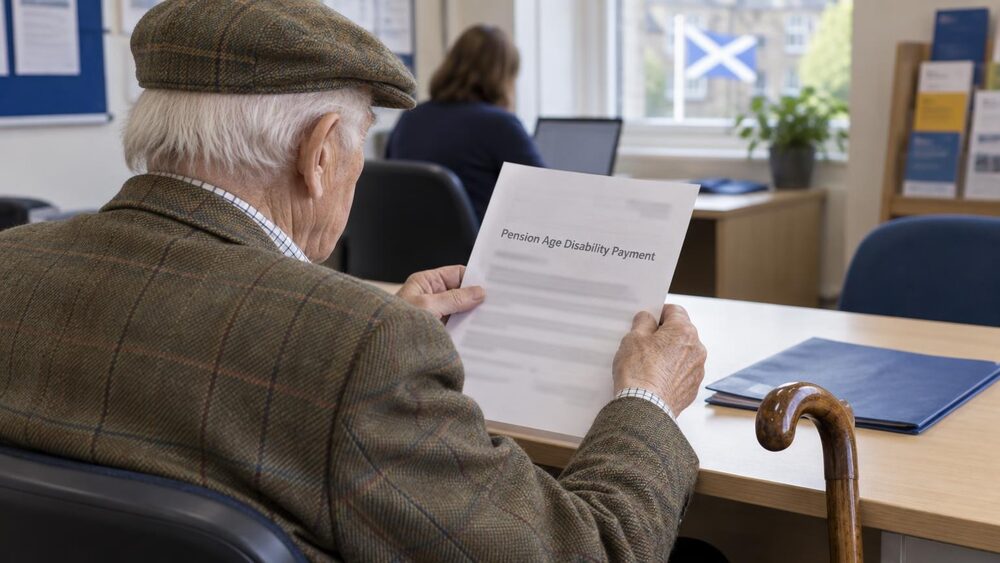
Pension Age Disability Payment is the disability benefit for people over State Pension age who live in Scotland. It is paid by Social Security Scotland, the executive agency of the Scottish Government responsible for delivering Scotland's social security benefits1, and it replaced Attendance Allowance, the equivalent benefit previously run by the Department for Work and Pensions (DWP)2. Since 22 April 2025, people in Scotland over pension age apply for Pension Age Disability Payment rather than Attendance Allowance3.
The payment is for people who are disabled or have a long-term health condition and need help looking after themselves, or supervision to keep them safe4. It comes in two weekly rates: £76.70 at the lower rate and £114.60 at the higher rate5. It is not means-tested, so savings, income and work do not affect it, and it is tax free6. There is no mobility component: unlike Personal Independence Payment or Adult Disability Payment, it pays only for care and supervision needs, not for getting around4.
What Pension Age Disability Payment is and who it is for
Pension Age Disability Payment is a weekly payment for people of State Pension age in Scotland who have a disability or long-term health condition and need assistance looking after themselves, or supervision to keep them safe, or who are terminally ill4. The legislation underpinning it allows payment in respect of an individual who has reached pensionable age, within the meaning given by the rules in paragraph 1 of schedule 4 of the Pensions Act 19958. In everyday terms, that means the qualifying age is State Pension age, which is itself rising over time.
The benefit is one of a family of Scottish payments that mirror GB-wide DWP benefits. Adult Disability Payment replaced Personal Independence Payment (PIP) and working-age Disability Living Allowance for people aged 16 up to State Pension age2, and Pension Age Disability Payment replaced Attendance Allowance for those above it2. People under 16 are covered by Child Disability Payment. So the dividing line between the Scottish benefits is age: if you have not yet reached State Pension age, the relevant benefit is Adult Disability Payment; once you have, it is Pension Age Disability Payment.
The benefit has a care component only9. There is no mobility component, so it does not pay anything towards the cost of getting around4. What it recognises is the need for help or supervision: the lower rate applies where that need arises during the day or the night, and the higher rate where it arises during both10.
The rollout happened in stages, and the dates matter for understanding which benefit applies to whom:
It was first introduced in pilot areas in October 2024, became available across Scotland on 22 April 2025, and the managed transfer of existing Attendance Allowance awards from the DWP was completed in Winter 20252. From 23 February 2026, people who move to Scotland while getting Attendance Allowance can also apply11.
Existing Attendance Allowance awards and moving to Scotland
If you were already getting Attendance Allowance when Pension Age Disability Payment was introduced, you did not need to make a new claim. Existing awards were moved across by a managed case transfer process run jointly by the DWP and Social Security Scotland, which was completed in Winter 20252. Your rate of payment carried over with the transfer, and Social Security Scotland became responsible for the payment and for any reviews from that point.
People who move to Scotland from elsewhere in the UK are treated differently depending on when they moved and what they were getting. From 23 February 2026, anyone who moves to Scotland and was getting Attendance Allowance at the time of their move can apply for Pension Age Disability Payment11. Before applying, it is worth checking how a move affects disability benefits generally, because the rules differ between benefits and between Scotland and the rest of the UK; the page on moving between Scotland and England sets this out.
If you move in the other direction, out of Scotland, the position reverses: Pension Age Disability Payment is a Scottish benefit and Social Security Scotland will tell you what happens to your award. In all cases the agencies write to you: Social Security Scotland and the DWP send letters explaining what happens next when a case is being transferred between them12.
Who can get it: age, care needs and living in Scotland
The eligibility rules have three parts: age, care needs and residence13.
Age. You must be of State Pension age or older13. The legislation defines this as pensionable age within the meaning of the Pensions Act 1995 rules, or 65 if that is higher8. People below State Pension age with a disability or long-term health condition claim Adult Disability Payment instead, which is available for new applicants aged between 16 and State Pension age14.
Care needs. You must need assistance looking after yourself, or supervision to keep you safe, because of a physical disability, mental disability or health condition, and those care needs must have lasted, or be expected to last, 6 months or more13. The legislation sets this out as a daytime condition, a night-time condition, or both, which must have been satisfied throughout the 26 weeks before the award begins8. In practice this is what separates the two rates: the daytime condition or the night-time condition alone qualifies for the lower rate, and both together qualify for the higher rate10.
Living in Scotland. You must be ordinarily resident in Scotland, habitually resident in the common travel area, not subject to immigration control, and present in the common travel area, having been present there for at least 26 weeks of the 52 weeks before the date of the award8. The residence and presence conditions do not apply where you have been granted refugee status or humanitarian protection, or are the dependant of such a person8. People with immigration concerns can read more about the habitual residence test and no recourse to public funds.
A diagnosis is not needed to claim6. What matters is how your condition affects the help or supervision you need, not what the condition is called. Attendance Allowance, the benefit Pension Age Disability Payment replaced, works the same way: it is for people of State Pension age with a physical disability, mental disability or health condition15.
Two weekly rates: £76.70 and £114.60
Pension Age Disability Payment has two weekly rates, set in legislation5. From 7 April 2026 the rates are:
| Rate | Weekly amount | Who gets it |
|---|---|---|
| Lower | £76.70 | Help or supervision needed during the day or the night5 |
| Higher | £114.60 | Help or supervision needed during both the day and the night, or terminally ill5 |
The rates rise each April. In 2025/26 the lower rate was £73.90 and the higher rate £110.40; in 2026/27 they are £76.70 and £114.6013. The uprating is made by amending the regulations: the 2025 amendment substituted £73.90 for £72.65 and £110.40 for £108.5516. How these annual increases work across all benefits is explained on the page about April uprating.
The payment is made every four weeks, so the amount that lands in a bank account is four times the weekly figure, based on the 2026/27 weekly rates of £76.70 at the lower rate and £114.60 at the higher rate5.
The rate you get depends on when you need help, not how much it costs or whether anyone is actually paid to care for you. You can qualify whether a partner, relative or neighbour provides the help unpaid, or you manage alone with difficulty: the test is the need for assistance or supervision13. If you are terminally ill, you get the higher rate automatically, no matter how long you have been ill or how long you are expected to live4.
Not means-tested and tax free
Pension Age Disability Payment is not means-tested. It does not matter if the person applying is working or has savings4. There is no savings limit, no earnings limit and no hours limit, and the payment is tax free7.
It also tends to help rather than reduce other benefits. Pension Age Disability Payment will not reduce other benefits you receive, such as Pension Credit, Housing Benefit or Council Tax Reduction, and it may lead to higher rates of these, because a disability payment can count as extra need in their calculations6. If you or your partner receive Pension Age Disability Payment, you are also exempt from the Benefit Cap, which limits the total amount certain households can receive in benefits17.
Getting Pension Age Disability Payment can also unlock payments for someone who cares for you. It is one of the qualifying benefits for Carer Support Payment, the Scottish replacement for Carer's Allowance, including where the award is made under the special rules for terminal illness9. The page on passported help explains what else a qualifying award can unlock.
If your award changes or stops later, for example after a review, that could affect these other benefits, and you would need to tell your local council, HM Revenue and Customs (HMRC) and the DWP about the change18.
How to apply: two parts, online, by phone, by post or in person
There are several ways to start an application4:
- Online at mygov.scot/pension-age-disability-payment, using a myaccount registration6
- By phone on 0800 182 2222, free4
- By post, using a paper form4
- In person, with help from Social Security Scotland staff4
The online and paper forms are only available in English, but you can apply by phone in another language6. A friend, family member, carer or advocate can apply on your behalf6, and there is more general information about appointees and third parties on this site.
The application is in two parts, unless you are terminally ill, in which case only the first part applies7. Part 1 gathers your key personal details. Part 2 asks about how your condition affects you: the help and supervision you need during the day and at night. The two-part structure is used across Social Security Scotland's disability benefits, and where part 1 is started online, part 2 is usually completed online as well19.
The date you start your application matters. If your application is successful, Social Security Scotland generally backdates your payment to the date you started it20. If you apply by phone or paper form, the earliest date they can pay you from is when you phoned to start the application process21. So it is worth starting the application, even if you do not yet have all your supporting information to hand, rather than waiting until everything is gathered.
How long a decision takes varies. The median average processing time for normal rules applications, from launch to 31 July 2026, was 8 working days13. Pension Age Disability Payment is a new service and demand is high, so some processes may take longer10. When a decision is made, you receive a letter telling you the rate you will receive, whether your award will be reviewed, and the date of your next review18.
Supporting information: what to send and who can provide it
Social Security Scotland asks for one piece of supporting information from a professional where possible, but a diagnosis is not needed, and an application can be made without supporting information4. Supporting information is simply evidence from someone who understands how your condition affects you day to day22.
It can come from two kinds of person22:
- a professional involved in your treatment or care, such as a doctor, nurse, social worker or occupational therapist
- a member of your wider support network, like a family member or friend
Suitable documents include a letter from a professional, or an official document such as a prescription list, a social care plan, a referral letter, or a letter about an assessment or appointment4. The equivalent guidance for Child Disability Payment gives the same examples: a letter from a professional, or an official document such as a prescription list, a letter from the child's school, or a letter about an assessment or appointment23.
If you submit your form without supporting information, you have 28 days to gather it yourself22. Uploading documents online is the fastest way to get them to Social Security Scotland22. If you need help gathering supporting information, you can call free on 0800 182 222222.
If you send photocopies by post, write on each one your full name, your date of birth, your National Insurance number, and the words "Pension Age Disability Payment", so Social Security Scotland can match them to your case22. There is no need to send a document again if they have already seen it: they only need to see information about changes22.
Terminal illness: fast-tracked under special rules
There is a separate fast-track process for people who are terminally ill. If a medical professional has said you have a terminal illness, you can claim Pension Age Disability Payment straightaway6. Under the Special Rules for Terminal Illness, you automatically get the higher rate, regardless of how long you have been ill or how long you are expected to live9. Only the first part of the application applies7.
To fast-track an application, Social Security Scotland needs confirmation of the terminal diagnosis from a doctor or nurse, provided on the BASRiS form (the Benefits Assessment under Special Rules in Scotland). No other supporting information is required4. The doctor or nurse completes the BASRiS form; you do not have to supply anything further.
Decisions under the special rules are prioritised. Social Security Scotland aims to make decisions within seven working days of receiving a completed application form and BASRiS form13. The median average processing time for special rules applications, from launch to 31 July 2026, was 2 working days13.
Payments under the special rules are made weekly in advance, rather than every four weeks in arrears4. The award can also be backdated to the date of diagnosis of terminal illness, up to a maximum of 26 weeks before the date of application13.
If an application under the special rules is not proceeding, for example because the BASRiS form does not confirm eligibility, Social Security Scotland will ask whether you wish to proceed with a standard application for Adult Disability Payment, Child Disability Payment or Pension Age Disability Payment24. The general page on Special Rules for Terminal Illness explains how these rules work across benefits.
How and when it is paid, and backdating
Pension Age Disability Payment is normally paid every 4 weeks, in arrears, for the previous 4 week period, into the account you gave in your application21. If you are terminally ill, it is paid weekly in advance instead4.
Backdating works from the date you start your application. If your application is successful, Social Security Scotland generally backdates your payment to that date20. This is why the agency stresses that it is important they know the date you start your application20. For phone and paper applications, the earliest date they can pay you from is when you phoned to start the application process21. Under the special rules for terminal illness, backdating can go further, to the date of diagnosis, up to a maximum of 26 weeks before the date of application13.
To change the account the payment goes into, call Social Security Scotland free21. If you want the payment to stop, for example because your circumstances have changed, contact Social Security Scotland to ask them to end it25.
Reporting changes, hospital stays and time abroad
If you get Pension Age Disability Payment, you need to tell Social Security Scotland about any changes to the help and support you need during the day or night26. This duty applies to people already receiving the payment, people who have applied but not yet had a decision, and people who have moved from DWP Attendance Allowance to Pension Age Disability Payment25.
When you report a change, it is quicker if you have the following information to hand27:
- your National Insurance number
- your bank account details
- details of the change
- the date the change happened or will happen
Where benefits are paid by other organisations, they each need to be told about changes to a Pension Age Disability Payment: the local authority, HMRC and the DWP28. A change to this payment can affect Pension Credit, Housing Benefit and Council Tax Reduction, which is why each body needs to know6. The general page on reporting a change of circumstances explains the wider duty and the risks of not reporting.
Time abroad is treated differently for people whose award was transferred from the DWP. Guidance on case transfer states that an individual who is temporarily abroad at the point of transfer is treated as present in the common travel area for 26 weeks from the date of transfer, so should not be excluded from entitlement during that period29. The general rules on going abroad and on payments in hospital cover the wider position across benefits.
Reviews, redeterminations and appeals
When Social Security Scotland make a decision about your application, they give you the date of your first review30. Awards are typically reviewed after a period of between 2 and 10 years13. If your needs are highly unlikely to change, you may be given an indefinite award, which means your award will not be reviewed in the future unless you tell them that something has changed18.
A new decision following a review is called a determination18. Social Security Scotland will tell you if your award will stop, reduce or increase after a review, and they will tell you why18. The length of time a review takes depends on your circumstances: it is sooner if you have no changes to report, and longer if you have more than one change30.
The outcomes of completed reviews to 31 July 2026 show that most reviews leave the award unchanged or increase it: of completed reviews, 32% resulted in an increase in award and 1% resulted in a decrease13.
If you disagree with a decision about your payment, you can challenge it. The Scottish process is called a redetermination: Social Security Scotland look at the decision again. If you are still unhappy after a redetermination, you can appeal to a tribunal. The pages on challenging a decision and appealing to a tribunal set out how each stage works and the time limits.
If your award is reduced or stopped, Short-term Assistance may be available. Pension Age Disability Payment is one of the benefits Short-term Assistance can apply to when an award is reduced or stopped31. It is intended to keep money coming in while a redetermination or appeal is decided, and the general page on payments during reconsideration explains the principle.
If an award changes or stops following a review, this could affect other benefits, and the local council, HMRC and the DWP each need to be told about the change18.
Where to get help
Social Security Scotland administers Pension Age Disability Payment and is the first point of contact for applications, changes, reviews and payment queries20. You can call free on 0800 182 22224. A Text Relay service is available on 18001 followed by 0300 244 4000 for people who are hard of hearing, and there is a webchat at chat.socialsecurity.gov.scot; British Sign Language users can use contactscotland-bsl.org4.
Independent help is also available. Independent Age publishes guidance on Pension Age Disability Payment, including on applying and on how the payment interacts with other benefits6. Disability Rights UK and Turn2us also publish guides to the payment and its rates7. The Age Scotland helpline offers free, confidential advice over the phone on 0800 12 44 222 for older people, their carers and families in Scotland32. For a wider check of what you might be entitled to, the page on free calculators and advisers lists the independent tools and services available.
Sources32 cited
- Social Security Scotland role Scottish Government, 2026-06
- Benefit combinations official statistics to March 2026 Department for Work and Pensions, 2026-09-15
- Public funds accessible Home Office, 2025-04-22
- Pension Age Disability Payment factsheet, March 2026 Social Security Scotland, 2026-03
- Pension Age Disability Payment Regulations 2024 legislation.gov.uk, 2024-06-06
- Pension Age Disability Payment advice Independent Age, 2026-09-26
- Pension Age Disability Payment Disability Rights UK, 2026-04-05
- Pension Age Disability Payment Regulations 2024, body legislation.gov.uk, 2024-06-06
- Assistance under Special Rules for Terminal Illness mygov.scot, 2025-03-24
- Pension Age Disability Payment decision mygov.scot, 2026-09-26
- Supporting clients moving to Scotland from the rest of the UK Social Security Scotland, 2026-02-23
- Adult Disability Payment reviews: transferred DWP cases mygov.scot, 2025-03-24
- Pension Age Disability Payment and Scottish Adult Disability Living Allowance statistics to 31 July 2026 Social Security Scotland, 2026-09
- Adult Disability Payment factsheet, March 2026 Social Security Scotland, 2026-03
- Attendance Allowance GOV.UK, 2026-09-25
- Pension Age Disability Payment (Amendment) Regulations 2025 legislation.gov.uk, 2025-03-27
- How much Pension Age Disability Payment will I get Turn2us, 2024-10-21
- Pension Age Disability Payment reviews mygov.scot, 2026-09-26
- Child Disability Payment statistics to 30 June 2026 Social Security Scotland, 2026-08
- Pension Age Disability Payment questions mygov.scot, 2026-09-26
- Pension Age Disability Payment payments mygov.scot, 2026-09-26
- Pension Age Disability Payment reviews: sending documents mygov.scot, 2026-09-26
- Child Disability Payment: what you need to apply mygov.scot, 2025-08-21
- Terminal illness: after you apply mygov.scot, 2025-03-24
- Pension Age Disability Payment changes mygov.scot, 2026-09-26
- Changes you need to report in a Pension Age Disability Payment review mygov.scot, 2026-09-26
- Letting Social Security Scotland know about a change mygov.scot, 2026-09-26
- Pension Age Disability Payment changes: what happens next mygov.scot, 2026-09-26
- Adult Disability Payment decision making guide: temporary time abroad Social Security Scotland, 2017-02
- Pension Age Disability Payment reviews: what you need to know mygov.scot, 2026-09-26
- Short-term Assistance mygov.scot, 2025-01-17
- Cost of living advice for older people Scottish Government, 2026-09-26
 Turn2usFree benefits calculator and grants search from a charity
 Citizens AdviceFree advice on money, consumer and legal problems in England and Wales
 GOV.UKOfficial information on tax, benefits and government services
 MoneyHelperFree, impartial money and pensions guidance, set up by government