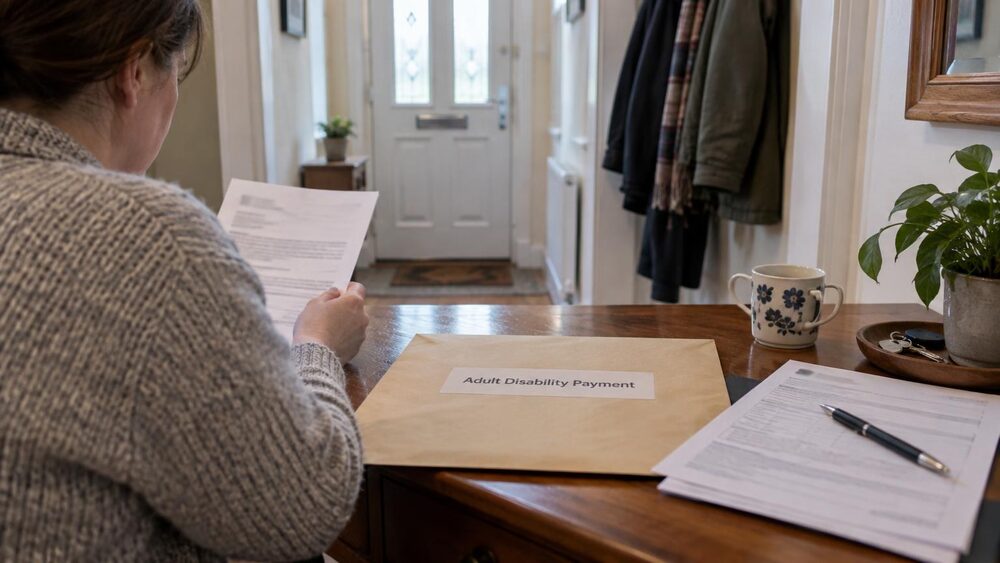
Adult Disability Payment (ADP) is the Scottish disability benefit that has replaced Personal Independence Payment and Disability Living Allowance for people in Scotland aged between 16 and State Pension age1. It is paid by Social Security Scotland, the executive agency of the Scottish Government, and it provides money to help with the extra daily living and mobility costs that a person living with a disability might have1. As of 31 July 2026, 510,150 people were in receipt of Adult Disability Payment1.
The payment is made up of two parts, daily living and mobility, and you may qualify for one or both2. It is not means-tested, it is tax-free, and it does not matter whether you are working or have savings3. The enhanced weekly rates are £114.60 for the daily living part and £80.00 for the mobility part2. Unlike PIP, there are no face-to-face assessments by a private contractor: decisions are made on the basis of your application form and supporting information, with consultations used only where needed4.
Adult Disability Payment replaced PIP in Scotland
Adult Disability Payment was launched nationally on 29 August 2022 and is one of four types of disability assistance delivered by Social Security Scotland7. It replaces PIP and DLA for people in Scotland aged between 16 and State Pension age1. Elsewhere in the UK, PIP continues: in England, Wales and Northern Ireland, DLA for adults has been replaced by PIP, and telling the DWP that your circumstances have changed while on DLA there means you will have to apply for PIP, even if that results in a lower amount8.
The scale of the change in Scotland is large. Between 21 March 2022 and 31 July 2026, there were 489,995 part 1 applications and 400,640 part 2 applications for Adult Disability Payment, and the total value of payments issued was £7.9 billion1. Of the 510,150 people receiving it at the end of July 2026, 308,505 (60%) had their award transferred from the Department for Work and Pensions and 201,645 (40%) were new applicants1. Social Security Scotland has now transferred all identified disability and carer benefit cases from the DWP9.
The legal basis is the Disability Assistance for Working Age People (Scotland) Regulations 2022, which set out the rules and eligibility criteria, including that Adult Disability Payment consists of a daily living component and a mobility component10. The benefit is administered entirely by Social Security Scotland rather than the DWP, which is why applications, reviews and challenges all go to the Scottish agency rather than to the UK Government.
Who can get Adult Disability Payment
To be eligible, you must be 16 or over, have a disability or long-term health condition or be terminally ill, and not have yet reached State Pension age2. You must also have lived with the disability or condition for at least 3 months and be expected to live with it for at least 6 months, unless you are terminally ill, in which case these duration rules do not apply2.
Young people can apply from age 15 years 9 months onwards, so that the transition from Child Disability Payment happens without a gap when they turn 167. At the other end of the age range, new applications are only possible before State Pension age: people who are already getting Adult Disability Payment stay on it and do not transfer to Pension Age Disability Payment when they reach State Pension age11. Applications by people under 15 or over 65 are significantly more likely to be withdrawn, because those ages fall outside the eligibility criteria and the correct benefit is Child Disability Payment or Pension Age Disability Payment instead1.
There is no income test and no savings test. Adult Disability Payment is not means-tested, so it does not matter if the disabled person is working or has savings3. Students can claim it too, and students with a mental health problem, long-term illness or any other disability can also receive Disabled Students' Allowance, which covers study-related costs, alongside it12. People who move to Scotland from another part of the UK can also apply: from 6 November 2025, anyone who moves to Scotland and was getting PIP at the time of their move can apply, with entitlement to Adult Disability Payment beginning on the day after the day their PIP ends9.
Daily living and mobility: the two parts and weekly rates
Adult Disability Payment is made up of two parts: daily living and mobility3. The daily living part is for help with tasks such as preparing food, eating, washing, bathing, dressing and communicating2. The mobility part may be paid if you need help going out, for example planning and following a route to another place, or moving around, for example walking14.
Each part has two weekly rates, a standard rate and an enhanced rate, set out in the legislation5. The enhanced rates are £114.60 a week for daily living and £80.00 a week for mobility2. The mobility enhanced rate was uprated to £80.00 from £77.05 by the Social Security (Up-rating) Order for 2026/2715. A transitional rate of £28.70 a week applies to the daily living component for a small group of transferring individuals entitled to that rate16.
Of the applications authorised by 31 July 2026, 53% were given an initial award comprising both the daily living and mobility components, 40% received daily living only and 7% received mobility only1. Daily living awards accounted for 69% of payments by value, with £5.4 billion issued, while mobility awards accounted for 31%, with £2.5 billion issued1.
If you get the enhanced rate of the mobility part, you can use some or all of it to lease a new car, scooter or powered wheelchair through the Accessible Vehicles and Equipment scheme, the Scottish equivalent of the Motability arrangements2. The comparison page on Motability versus keeping your mobility allowance explains the trade-offs involved.
How the points assessment decides your award
You will be assessed for Adult Disability Payment based on your application form, and the assessment gives points depending on how difficult it is for you to do a range of activities14. There are 12 activities in total, split between daily living and mobility. If you get under 8 points in either the daily living or the mobility part, you cannot claim that part of ADP18. Reaching the standard rate threshold and the enhanced rate threshold depends on the total points scored across the activities for that part.
A point worth remembering is that ADP is not awarded on the basis of a diagnosis. It is given based on how you manage daily living tasks such as washing, dressing and preparing food, and how you get around18. Two people with the same condition can therefore receive very different awards, because what counts is the effect of the condition on day-to-day life rather than the condition itself. The most common categories of primary disabling condition among people receiving ADP as of 31 July 2026 were mental and behavioural disorders (41%), diseases of the musculoskeletal system and connective tissue (24%) and diseases of the nervous system (7%)1.
Your decision letter will include a list of the points awarded for each of the 12 activities and explain why you were awarded those points4. By law, the letter must be clear and accessible and give guidance and explanations about the decision4. If you disagree with the points awarded, that letter is the starting point for challenging the decision, which is done through a process called redetermination rather than the mandatory reconsideration used for DWP benefits (see challenging a decision).
How to apply: a two-part application
You apply for Adult Disability Payment in two stages17. Part 1 gathers your personal details and sets the usual start date for payment; part 2 asks about how your condition affects your daily life and your ability to get around1. Once part 1 has been filled out, you have eight weeks to complete part 2, and you will receive a reminder two weeks before the end of that period1.
Applications can be made online at mygov.scot/adultdisability, in person, over the phone, or by paper form by post, and you can call Social Security Scotland free on 0800 182 2222 for help2. Part 2 asks for information about your condition, including any medication or treatment you are having, medical tests and their results, and your GP's contact details or details of other healthcare professionals14. The first payment is usually calculated from the date part 1 was submitted, whether online, over the phone or by post, which is why submitting part 1 as early as possible matters for backdating2.
If you are applying for someone who is terminally ill, there is only one stage, to make the process faster17. The terminal illness route is covered in full below.
Supporting information and how long a decision takes
Social Security Scotland needs 1 piece of supporting information from a professional, such as a diagnosis, social care plans, prescription lists or referral letters2. A diagnosis is not needed to apply2. This is a deliberately lighter requirement than the evidence gathering that many people expect: one document from a professional who knows your situation is enough for the application to proceed.
Decision times have been affected by high demand and because Adult Disability Payment is a new service, and Social Security Scotland says some processes may take longer for those reasons4. The statistics bear this out. Of applications with a decision by 31 July 2026, 48% had been processed within 60 working days (about 3 months), and 4% had taken 141 or more working days1. The median processing time from part 2 being received for normal rules applications was 62 working days since launch, but it rose from 62 days in April 2026 to 86 days in July 20261.
| Measure | Time |
|---|---|
| Median processing, normal rules, since launch | 62 working days1 |
| Median processing, normal rules, July 2026 | 86 working days1 |
| Processed within 60 working days | 48% of decided applications1 |
| Median processing, special rules (terminal illness) | 2 working days1 |
Of the 443,820 applications processed with a decision by 31 July 2026, 43% were authorised, 54% were denied and 3% were withdrawn1. An earlier figure from the Independent Review of Adult Disability Payment, covering applications decided by 30 April 2025, put the proportion authorised at 47%20. The review also made recommendations to improve decision-making, including that the outcomes of caselaw decisions should be reflected in decision-making guidance and training20.
Terminal illness: a fast-track route with the highest rates
There is a separate fast-track application process for people who are terminally ill3. A person with a terminal illness will be automatically entitled to the highest rate of the daily living and mobility parts, regardless of how long they have had the terminal illness3. The award is a lifetime award, reviewed only on a change of circumstances, and it is paid weekly in advance rather than every 4 weeks2.
Under the Special Rules for Terminal Illness, you automatically get the highest award for daily living and the highest rate for mobility, ongoing without review unless your circumstances change21. The legislation achieves this by treating terminally ill clients as receiving the maximum number of points for all daily living and mobility activities, as though they had satisfied the criteria for the enhanced rates of both components16. Of the people in receipt of Adult Disability Payment at 31 July 2026, 8,530 (2%) were eligible under the Special Rules for Terminal Illness1.
The application under special rules has one stage rather than two, and Social Security Scotland aims to make a decision in around 7 working days4. The median processing time for special rules applications since the pilot launched in March 2022 has been 2 working days1. Where the date of clinical judgement is earlier than the date of application, the application can be backdated to a maximum of 26 weeks21. The dedicated page on Special Rules for Terminal Illness explains the process in more detail.
Moving from PIP, DLA or Child Disability Payment
If you get PIP, it will be moved to Adult Disability Payment; you do not need to apply, and the process of transferring a person's award usually takes between 4 and 8 weeks22. Social Security Scotland has now transferred all identified disability and carer benefit cases from the DWP9. Before 21 March 2025, some people who got Disability Living Allowance for adults had their benefit moved to Adult Disability Payment; others moved to Scottish Adult Disability Living Allowance, with more than 66,870 people transferred to that caseload22. Some 167,500 people have had their award transferred to Pension Age Disability Payment23.
After your benefit has moved, Social Security Scotland may review your Adult Disability Payment22. Reviews are based on the information Social Security Scotland holds and any new information you provide, and they ask about changes to your day time and night time care needs24. When a review is complete, a new decision called a determination is made24.
Young people receiving Child Disability Payment move to Adult Disability Payment at 16, and can apply from age 15 years 9 months onwards so there is no gap7. The Child Disability Payment application is also a two-part process, with part 1 gathering key personal details and part 2 detailing the impact of the disability7. People moving between Scotland and the rest of the UK should read disability and carer payments when moving between Scotland and the rest of the UK, because entitlements change at the border.
Challenging a decision: redetermination and appeal
If you do not agree with a decision, you have the right to ask Social Security Scotland to take a fresh look at it, called a redetermination25. A request for a redetermination should be made within 42 calendar days of being notified of the determination23. You can request a redetermination online, by calling Social Security Scotland free on 0800 182 2222, or by completing a paper redetermination form17. Social Security Scotland then has 56 calendar days to make the redetermination23.
The decision letter is called a notice of determination17. If you still disagree after the redetermination, you can appeal to a tribunal, and an appeal can also be made if the redetermination cannot be completed within the required timescale7. Appeals for Adult Disability Payment can be requested online or by filling in an appeal request paper form26. The median average processing time for redeterminations completed since the benefit was launched was 50 calendar days, and 52 calendar days in July 20261. For comparison on the equivalent DWP process, see mandatory reconsideration versus tribunal appeal.
Short Term Assistance is available during a redetermination or appeal of a decision that reduced or removed entitlement, so payments continue while the challenge is considered7. For Child Disability Payment, 12,030 redetermination requests had been decided by 30 June 2026, of which 52% were allowed and 43% disallowed, which gives a sense of how often a fresh look changes the outcome7.
Going abroad, changes of circumstances and extra help
Temporary absence from the UK does not automatically end entitlement, but the rules are strict. The time limits begin on the date of transfer for people temporarily abroad at that point27. Absence for medical treatment can be allowed for a 26-week period where the treatment is for a disease, or bodily or mental disablement, which started before the claimant left the UK, and where the treatment is undertaken by or under the supervision of a person appropriately qualified to carry it out28. Falling ill on holiday abroad does not qualify: a claimant who is absent for the purpose of being treated for an illness that began after leaving the UK would not satisfy the requirement28. The general rules on going abroad explain how absences affect benefits across the UK.
Changes of circumstances must be reported to Social Security Scotland, by calling free on 0800 182 2222 or by uploading the paper form29. Social Security Scotland can help if you are not sure whether a change needs to be reported, if you are calling from abroad, or if you need support completing the change of circumstances form30. Forms can be provided in a language other than English on request31. The page on reporting a change of circumstances explains why prompt reporting matters.
Getting Adult Disability Payment can unlock other help. Recipients are exempt from the benefit cap32. Telling the Housing Benefit office or Universal Credit that you are getting Adult Disability Payment matters because it can increase those awards through a disability element32. Extra support linked to ADP is available from Social Security Scotland, and the page on passported help explains what a qualifying award unlocks more generally33.
Contacting Social Security Scotland and getting free help
Social Security Scotland can be reached free on 0800 182 2222, by webchat at chat.socialsecurity.gov.scot, and by Text Relay on 18001 +0300 244 4000 for people who are hard of hearing34. British Sign Language users can make contact through contactscotland-bsl.org34. The agency can help with questions about applications, reviews and changes, and can support you in completing forms30.
Free independent help is also available. Macmillan supports people affected by cancer with Adult Disability Payment claims, including how to claim and what the decision letter means14. Carers UK Scotland publishes guidance on Adult Disability Payment and related carer benefits17, and One Parent Families Scotland publishes advice on challenging decisions from Social Security Scotland26. For a wider check of what you may be entitled to, the page on free calculators and advisers lists independent tools.
Sources35 cited
- Adult Disability Payment statistics to 31 July 2026 Social Security Scotland, 15 September 2026
- Adult Disability Payment factsheet, January 2026 Social Security Scotland, 2026
- Adult Disability Payment factsheet, March 2026 Social Security Scotland, March 2026
- Adult Disability Payment: the decision mygov.scot, 24 March 2025
- The Disability Assistance for Working Age People (Scotland) Regulations 2022 legislation.gov.uk, 2022
- Adult Disability Payment: payments mygov.scot, 24 March 2025
- Child Disability Payment statistics to 30 June 2026 Social Security Scotland, August 2026
- Disability Living Allowance for adults Macmillan Cancer Support, 2025
- Supporting clients moving to Scotland from the rest of the UK Social Security Scotland, 27 January 2026
- The Disability Assistance for Working Age People (Scotland) Regulations 2022 (PDF) legislation.gov.uk, 2022
- Pension Age Disability Payment factsheet, March 2026 Social Security Scotland, March 2026
- Disabled Students' Allowance GOV.UK, 26 September 2026
- The Disability Assistance for Working Age People (Scotland) Regulations 2022, Part 2 legislation.gov.uk, 2022
- How to claim Adult Disability Payment Macmillan Cancer Support, 2025
- The Social Security (Up-rating) Order 2026 legislation.gov.uk, 2 March 2026
- The Disability Assistance for Children and Health Conditions (Miscellaneous Amendments) (Scotland) Regulations 2022 legislation.gov.uk, 21 June 2022
- Adult Disability Payment (Scotland) Carers UK Scotland, 26 September 2026
- Adult Disability Payment Macmillan Cancer Support, 2025
- Beginning an Adult Disability Payment application Social Security Scotland, 2017
- Independent Review of Adult Disability Payment: final report Scottish Government, 31 July 2025
- Assistance under Special Rules for Terminal Illness mygov.scot, 24 March 2025
- Adult Disability Payment reviews: transferred from DWP mygov.scot, 24 March 2025
- Pension Age Disability Payment and Scottish Adult Disability Living Allowance statistics to 31 July 2026 Social Security Scotland, September 2026
- Pension Age Disability Payment reviews: what you need to know mygov.scot, 26 September 2026
- Pension Age Disability Payment reviews mygov.scot, 26 September 2026
- Challenging a decision from Social Security Scotland One Parent Families Scotland, 9 March 2026
- Case transfer for Adult Disability Payment: temporary time abroad Social Security Scotland, 2017
- Residence and presence for Adult Disability Payment: temporary absence Social Security Scotland, 2017
- Changes you need to report in a Pension Age Disability Payment review mygov.scot, 26 September 2026
- Pension Age Disability Payment: changes mygov.scot, 26 September 2026
- Scottish Adult Disability Living Allowance change of circumstances form mygov.scot, 26 September 2026
- Adult Disability Payment and other benefits Turn2us, 26 September 2026
- Adult Disability Payment: extra support mygov.scot, 24 March 2025
- A guide to our benefits Social Security Scotland, March 2026
- Family payments factsheet Social Security Scotland, March 2026

 Turn2usFree benefits calculator and grants search from a charity
 Citizens AdviceFree advice on money, consumer and legal problems in England and Wales
 GOV.UKOfficial information on tax, benefits and government services
 MoneyHelperFree, impartial money and pensions guidance, set up by government