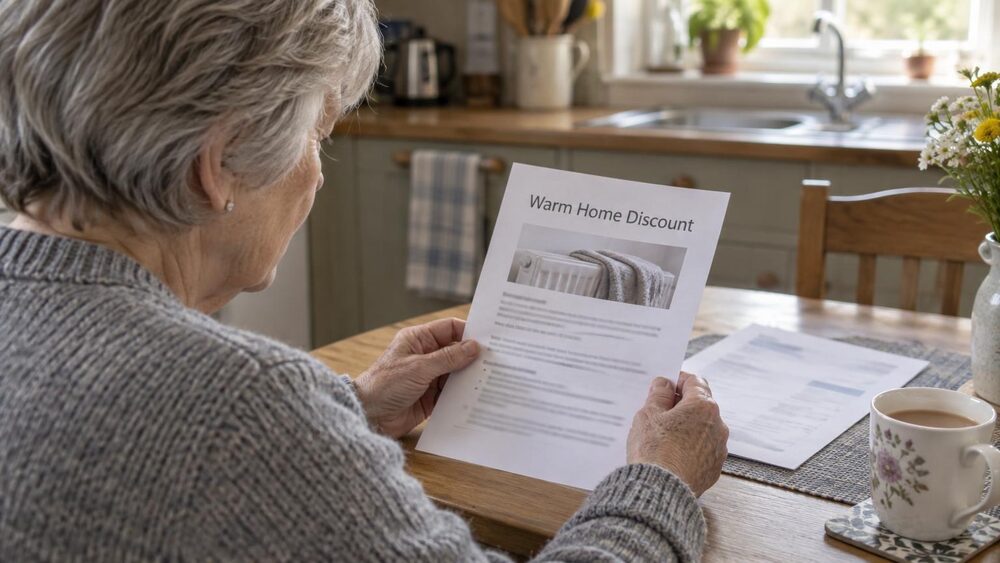
The Warm Home Discount is a one-off £150 reduction on your winter energy bill, paid through your electricity supplier rather than by the government directly1. It runs in England, Scotland and Wales, and around 6 million households are expected to receive it this winter2. Most people who qualify do not need to apply at all: the government matches benefit records against energy accounts and the supplier applies the credit automatically2.
The scheme is aimed at households in, or at risk of, fuel poverty. It is funded by a levy on all domestic gas and electricity customers rather than out of taxation, which means the cost is spread across everyone's bills3. This page explains who qualifies in each part of Great Britain, when letters arrive, how the money actually reaches you, and what other help exists if the discount is not enough, from supplier hardship funds to the rules that protect you from disconnection.
Warm Home Discount: £150 off your winter energy bill
The Warm Home Discount scheme requires large domestic energy suppliers to provide an annual discount of £150 to eligible households1. It is a credit against your electricity account, not cash paid to you, and it is applied once per winter rather than as a monthly saving. The scheme operates between October and March each year, with suppliers in most cases required to have applied the discount by 31 March of the scheme year2.
The scheme has grown substantially. Following changes made for winter 2025/26, the number of households receiving the rebate rose to around 6 million, an increase of around 2.7 million on the previous year3. The expansion also almost doubled the number of households with children receiving the discount, to 1.9 million7. The legislation now in place continues the scheme in England and Wales until 31 March 20308.
Because the discount is funded through a levy on bills, households that do not qualify also pay towards it. Consumer Scotland notes the Warm Home Discount is due to increase to an average cost of £37 a year for a typical dual fuel billpayer9. The same analysis points out that the discount is not indexed in any way: it has risen from £120 to £150 since 2011 while bills have risen 57% over that period, so its real value falls each year prices increase9. Consumer Scotland also estimates the scheme reaches 45% of fuel poor households from scheme year 2025/26 onwards9.
The scheme is administered and enforced by Ofgem, the energy regulator, and it reopens each autumn: rebate payments for the coming scheme year start to be issued from autumn 20262.
Who qualifies in England and Wales
In England and Wales there are two routes into the discount. The first is the core group: households where the person named on the energy bill, or their partner, receives a qualifying benefit on the qualifying date for that scheme year2. For winter 2026/27 the qualifying date is 23 August 20264. The qualifying benefits include Pension Credit (both the Guarantee Credit and Savings Credit elements), Housing Benefit, income-related Employment and Support Allowance, income-based Jobseeker's Allowance, Income Support and Universal Credit3.
The second route is for people on a low income who meet their supplier's own criteria. StepChange describes the two conditions as: get the Guarantee Credit element of Pension Credit, or be on a low income6. Independent Age sets out the practical test for 2026/27: you or your partner get certain benefits including Pension Credit, Universal Credit, Housing Benefit or income-related ESA, your or your partner's name is on the electricity bill, and your supplier is signed up to the scheme, with all of these applying on the qualifying date10.
Two changes are worth knowing. First, the high-cost-to-heat element of eligibility was removed for winter 2025/26, which is what allowed the scheme to expand so far3. Second, eligibility to a disability benefit alone no longer provides automatic access in England and Wales11. If you receive a disability benefit but nothing else, you may still qualify through your supplier's low income criteria, but you will not be matched automatically.
The rules also cover situations that used to catch people out. Someone who is temporarily in hospital, a care home or a hospice is treated as continuing to occupy their home, so a temporary stay does not end eligibility8. The same regulations extend eligibility to occupiers of mobile homes who meet the published criteria8. And if your benefits claim or Pension Credit was backdated to 24 August 2025 or before, you may still be able to get the discount6.
Who qualifies in Scotland
Scotland runs the same £150 discount but with a different structure, and the difference matters for how it is claimed. There are two groups: the core group and the broader group5. Under the current scheme, only recipients of the Guarantee Credit element of Pension Credit are automatically data matched in Scotland3. Scottish households on Guarantee Pension Credit receive a letter telling them they qualify, while those on other benefits apply via their energy supplier10.
The broader group works differently: you must be on a low income and meet your energy supplier's own criteria for the scheme6. Suppliers set these criteria themselves, so they differ between companies, and you apply directly to your supplier. Entitled to notes that broader group applicants should apply as soon as possible because the number of rebates is limited, with some suppliers opening applications in September and some in October11.
Scotland is also changing. From the 2026/27 scheme year, core group eligibility in Scotland will be aligned to the same qualifying benefits as the Scottish Winter Heating Payment3. Turn2us describes the automatic core group in Scotland as including people receiving certain means-tested benefits, such as those with an extra Universal Credit payment for disability, or caring for a child under five while receiving Universal Credit and not working12. Around 250,000 households in Scotland will get the discount automatically for the first time under the expanded arrangements13. Scottish households who get other means-tested benefits will need to apply via their energy supplier from October 202613.
The Scottish regulations set out how the rebate must be delivered: by crediting the customer's electricity account, or the gas account on request, or by providing credit for pre-payment customers, in each case reducing the amount charged, including VAT, by the rebate14.
Most people get it automatically: letters and the qualifying date
Most eligible households do nothing and the discount simply appears. In 2024 to 2025, over 95% of all core groups across Great Britain were data matched this way15. Last winter, around 2.9 million households, 92% of recipients, received their rebates automatically without taking any action; the remaining 250,000, or 8%, received theirs after contacting the Warm Home Discount helpline to confirm eligibility7. This winter, around 5 million rebates are expected to go to customers who have been correctly matched, and over 7 million letters will be sent across Great Britain in total15.
Not every letter means you have the discount. Around 2 million letters are expected to go to customers where the data match was incomplete, to encourage them to contact the helpline15. If you are eligible, you will receive a letter between November and January telling you about the discount4. Suppliers contact customers who qualify between late October and early January16.
If no letter has arrived by January 2027 and you think you qualify, call the Warm Home Discount helpline13. Independent Age advises making sure you get in touch by 26 February 20274. The qualifying date for winter 2026/27 is 23 August 2026: your circumstances on that date, not on the day you call, determine eligibility4.
How the discount reaches you: credit, gas account or prepayment voucher
The £150 is a credit, not cash. Direct debit customers are credited £150 to their electricity account or, if requested, to their gas account2. Some customers may instead receive a voucher or cheque redeemable at a Post Office or PayPoint shop2. Shelter confirms it is not a cash payment and does not affect your benefits17.
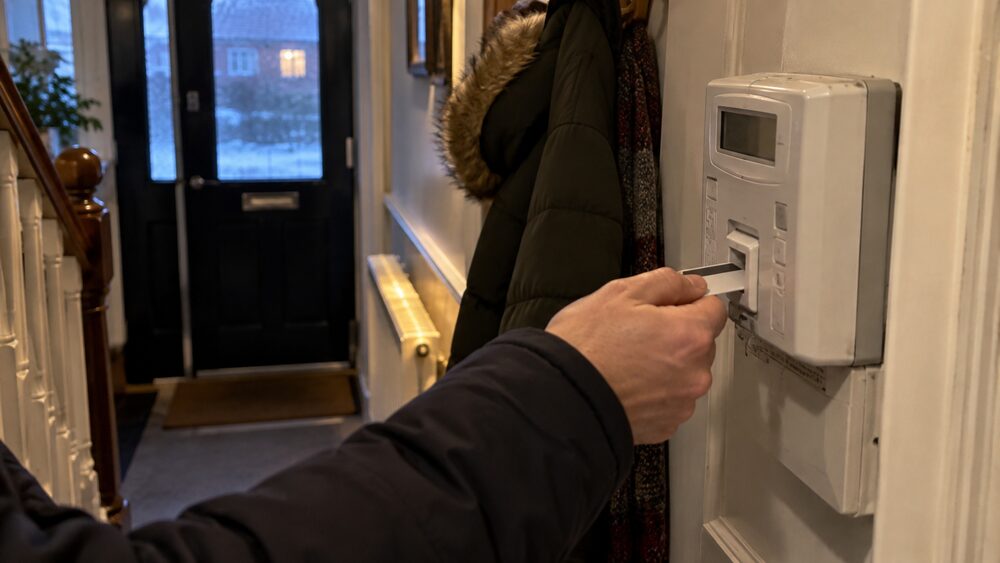
If you have a prepayment or pay-as-you-go meter, you can still get the discount if you are eligible5. Your supplier will confirm how: it might be a voucher to top up your meter, or credit applied directly13. Age UK says prepayment meter users will probably be given a top-up voucher4. For dual fuel customers with a combined plan for gas and electricity from the same supplier, the discount may be applied to the gas bill instead4.
In Scotland, the delivery methods are set in regulations: crediting the electricity account, crediting the gas account on request, or providing pre-payment credit against future electricity or gas use, in each case reducing the amount charged including VAT14. Whatever the method, your supplier must apply the discount by 31 March 20275.
Switching supplier and the Warm Home Discount
Switching can affect the discount, and the timing matters more than the destination. If you were not with a participating supplier on the qualifying date and switch to a participating supplier afterwards, you will not receive the discount for that scheme year2. Which? puts it more bluntly: if you switch away from a supplier that offers the discount to one that does not, you lose it, even if you are in the core group13.
Not every brand that bills you holds its own supply licence. Some obligated suppliers work with white label providers, which do not hold a licence but offer the Warm Home Discount to their customers through the licensed supplier's partnership2. If you are with a smaller brand, it is worth checking whether it offers the discount before switching.
The scheme itself only obliges suppliers with at least 1,000 domestic customers; smaller suppliers can offer it voluntarily8. Energy companies with more than 1,000 domestic customers must pay the Warm Home Discount, and smaller suppliers can choose to13.
If a supplier closes, the position is better than with switching. The account is transferred automatically to a new supplier chosen by Ofgem, and the discount continues to be available from the new supplier13.
Two practical points on switching generally: you do not need your landlord's permission to switch unless bills are included in your rent17, and most companies offer a discount for paying by direct debit, while some offer a dual fuel discount if you get gas and electricity from the same firm18.
Where the Warm Home Discount does not apply: Northern Ireland and park homes
The scheme does not run in Northern Ireland, where separate support is available15. StepChange confirms the Warm Home Discount is not available in Northern Ireland6, and Marie Curie says the same for the families it advises19. Northern Ireland has its own arrangements: households there received £63 of cost of living support under a scheme announced by the economy minister20. The Household Electricity Discount Scheme there works differently too, with pre-pay and keypad customers receiving the discount automatically at their meter when they top up20.
Park homes are a special case within Great Britain. If you live in a park home, you cannot get the discount through an electricity account in the usual way, because your supply usually runs through the site owner. Instead, you apply for the Park Homes Warm Home Discount, which pays a cheque towards your winter fuel bill10. Applications are handled by Charis Grants on behalf of contributing suppliers, and you can apply via Charis from September 202613. The Park Homes scheme is run by a third party and funded by participating energy suppliers as part of the scheme's Industry Initiatives funding7.
The government consulted on expanding the Park Homes scheme but decided not to proceed with the expansion at the current time3, a decision confirmed in the amendment regulations21.
The energy price cap limits the price per unit, not your bill
The Ofgem energy price cap sets the maximum unit price per kWh and the maximum daily standing charge energy suppliers can charge22. It was introduced by Ofgem in 2019 to ensure fair prices for customers who do not actively switch23. The cap level varies by energy supply region, payment method and type of electricity meter, such as standard or economy 722.
The cap is often quoted as a single annual figure for a typical household. In January 2026 the cap rose slightly, by 0.2%, to £1,758 per year for a typical household using electricity and gas and paying by direct debit24. It has been rising since: the Scottish Government reported a 12.6% increase in the energy price cap in July 202625, and Consumer Focus Scotland notes the cap rose by 13% for the July to September period as a result of rising wholesale prices26. Which? reports the cap increased on 1 October 2026 to a three year high, and predicts a further 9% rise in January, adding another £12 to the typical monthly bill23.
Two limits on the cap are worth knowing. First, it does not apply to fixed tariffs23, so a household on a fixed deal is not protected by it in the same way. Second, it caps the price per unit, not the total bill: if you use more energy, you pay more. Households without a prepayment meter have their rate set at the cap, while households with a prepayment meter receive a standing charge discount so that they do not pay more than direct debit customers12.
Help from your supplier if you cannot pay your energy bill
If you cannot pay, your supplier has obligations and, in most cases, funds set aside. Suppliers can change your payment plan so it is more affordable, give you more time to pay, offer access to hardship funds or grants, and offer advice on how to use less energy27. You can also ask your supplier to delay your bill, remove late payment charges, or allow you to pay over a longer period28.
Most major energy suppliers run hardship funds to support customers who fall into arrears, offering support such as grants to write off debt, and energy efficient white goods and appliances29. Research for the University of Bristol's Personal Finance Research Centre adds that suppliers should not insist on debt being paid off within a set number of months, and should avoid very long repayment plans, with flexibility over the day of the month the bill is due, how often it is paid, and by what means29.
Some suppliers also offer indirect help as part of the Warm Home Discount scheme, such as advice on using less energy and help with reducing energy-related debts4. Beyond your supplier, the Home Heating Support Fund may be able to help people struggling to pay their energy bills, including those who are rationing their own energy use, by making a payment to your energy supplier30.
If you cannot afford to top up your prepayment meter, contact your energy supplier to check whether it has grants available31. Homeowners may also qualify for grants to improve energy efficiency: in England, the Warm Homes: Local Grant provides funding through local councils, and the Affordable Warmth Scheme offers grants for efficiency measures32. Free, impartial help with checking what you are entitled to is available through benefit calculators and advisers, and the full range of benefits in the UK is covered elsewhere on this site.
Rules on disconnection and prepayment meters
Energy is a priority bill, and the rules on cutting people off are strict. Suppliers should only cut off your supply as a last resort, must give you notice first, and cannot cut off your supply unless they have first offered you a range of payment methods33. You must be asked if you want a prepayment meter before your supply is disconnected, if it is safe to install one34. Non-domestic suppliers do not have to offer a prepayment meter before disconnection, and the position can differ if you live at your business premises, depending on your contract type; once a prepayment meter is fitted, the supplier cannot disconnect you34.
Prepayment meters carry their own protections, because running out of credit means cutting yourself off. Ofgem's licence conditions require suppliers to offer Emergency Credit and Friendly-hours Credit to prepayment customers, unless it is technically unfeasible35. Before or when a meter is installed, the supplier must give the customer appropriate information about the advantages and disadvantages of the meter, its operation, the Emergency Credit, Friendly-hours Credit and Additional Support Credit facilities, and the procedures for removing or resetting the meter35. Suppliers must also take all reasonable steps to identify, on an ongoing and continuous basis, whether a customer is self-disconnecting35.
For comparison, water companies are barred from threatening to disconnect any property in which someone has their only or principal home, whether directly or by implication36. Energy suppliers retain the power in law, but the rules above constrain how they use it.
Sources36 cited
- Warm Home Discount statistics, 2025 to 2026 GOV.UK, 2026-06-18
- Warm Home Discount eligibility Ofgem, 2026
- Continuing the Warm Home Discount scheme: government response GOV.UK, 2026-01-30
- Warm Home Discount Age UK, 2026-09-15
- Warm Home Discount Scheme: England, Scotland and Wales Turn2us, 2026-09-08
- Warm Home Discount StepChange, 2026-09-25
- Expanding the Warm Home Discount scheme 2025 to 2026: consultation document GOV.UK, 2025-02-25
- The Warm Home Discount (England and Wales) Regulations 2026 legislation.gov.uk, 2026-03-27
- Response to DESNZ consultation on continuing the Warm Home Discount scheme Consumer Scotland, 2025-11-21
- Financial help in cold weather Independent Age, 2026-09-26
- Warm Homes Discount entitledto, 2026-09-26
- Help with household bills Contact, 2026-08-27
- Warm Home Discount Which?, 2026-08-04
- The Warm Home Discount (Scotland) Regulations 2026 legislation.gov.uk, 2026-04-30
- Continuing the Warm Home Discount scheme: consultation document GOV.UK, 2025-09-25
- How to get support if you miss out on the Winter Fuel Payment Which?, 2025-10-04
- Help with gas and electric bills Shelter England, 2025-07-25
- Switching utility providers StepChange, 2026-09-25
- Energy bills Marie Curie, 2026-03-30
- Households to receive £63 cost of living support Northern Ireland Executive, 2026-09-17
- The Warm Home Discount (Amendment) Regulations 2025, explanatory memorandum legislation.gov.uk, 2025
- Fuel poverty scenario modelling based on Ofgem energy price caps Scottish Government, 2026-09-02
- What is the energy price cap? Which?, 2026-08-27
- Scottish Economic Bulletin December 2025 Scottish Government, 2026-01
- Scottish Economic Insights September 2026 Scottish Government, 2026-07
- Improving outcomes for consumers in Scotland living in or at risk of fuel poverty Consumer Focus Scotland, 2026-01
- Struggling to pay energy bills Christians Against Poverty, 2026-08-20
- Emergency grants, loans and money help Shelter England, 2026-07-03
- Powering up support University of Bristol Personal Finance Research Centre, 2025-10
- Dealing with high gas and electricity bills Business Debtline, 2026-09-26
- Energy grants if you cannot afford your prepayment meter mygov.scot, 2026-02-04
- Help with energy efficiency measures Turn2us, 2026-09-08
- Your priority debts Business Debtline, 2026-09-26
- Emergency situations Business Debtline, 2026-09-26
- Notice of modification: self-disconnection and self-rationing, electricity Ofgem, 2020-10-19
- Paying fair: guidelines for water companies Ofwat, 2022-05-25

 Turn2usFree benefits calculator and grants search from a charity
 Citizens AdviceFree advice on money, consumer and legal problems in England and Wales
 GOV.UKOfficial information on tax, benefits and government services
 MoneyHelperFree, impartial money and pensions guidance, set up by government